Beginning
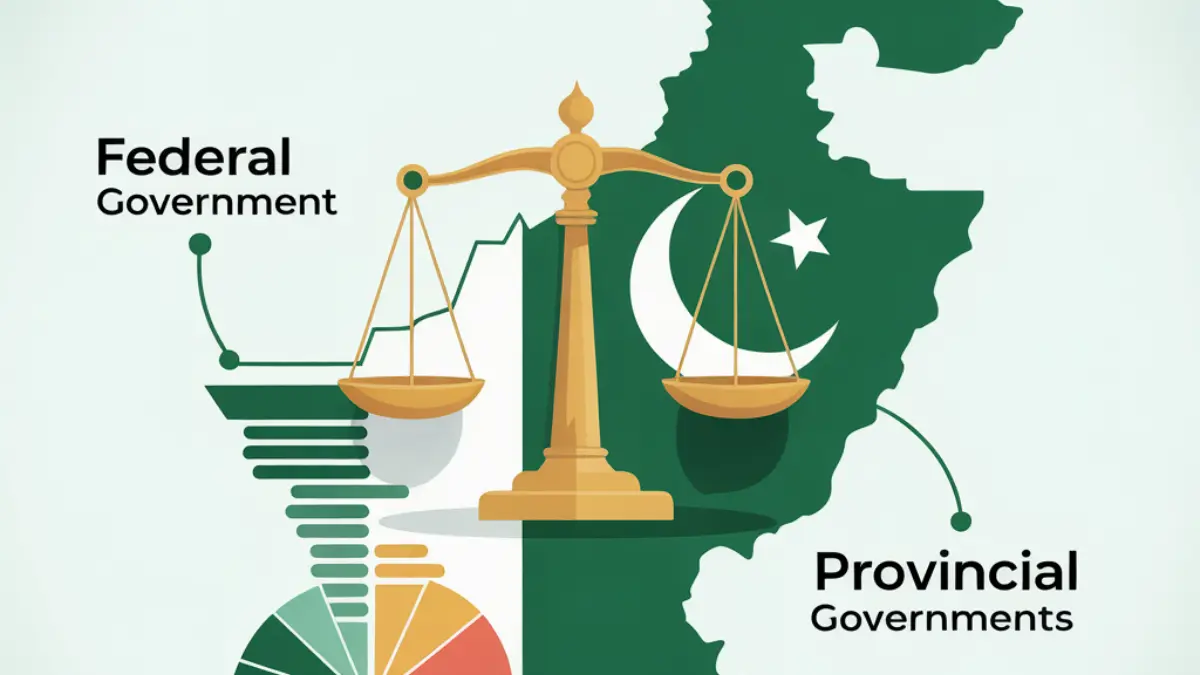
One of the most significant jobs in Pakistan’s intricate government is to split up money between the federal government and the provinces. It’s not easy to find a balance between the demands of the country and the progress of regions. In this case, the National Finance Commission (NFC) is quite significant. The Constitution indicates that the NFC is a constitutional organisation that gives advice on how to split up money, notably tax money, between the provinces and the centre. Think of it as the country’s money referee, making sure that everyone gets their fair share of the money. The choices made by the NFC have a direct effect on the quality of services like healthcare, education, roads, and policing in the provinces where average people live. This article breaks down the NFC’s goal, procedure, and massive effect into simple, easy-to-follow steps. It also talks about why the NFC is so crucial for Pakistan’s federal democracy.

- What does the National Finance Commission (NFC) do?
Article 160 of the Constitution of Pakistan created the National Finance Commission as a constitutional entity. It meets every five years to talk about how to split up money between the federal and provincial governments. The NFC Award shows how percent of the total amount of specific taxes goes to the provinces and how that amount is divided up among them.
- Why does Pakistan need an NFC?
There are four provinces in Pakistan: Punjab, Sindh, Khyber Pakhtunkhwa, and Balochistan. The federal government runs some areas as well. The provinces are responsible for things like health care, education, farming, and running the local government. The federal government, on the other hand, takes in most of the main taxes, like income tax, sales tax on commodities, and customs fees. If there isn’t a mandated sharing formula, provinces might run out of money, which would lead to inequity, instability, and a weaker federation. The National Finance Commission takes sure that: * Fair Distribution: Resources are shared fairly. * Provincial Autonomy: Provinces are guaranteed the money they need to run. * National Cohesion: It strengthens the federation by addressing complaints about resources. * Balanced Development: It aims to close the gaps between provinces.

- Who is on the NFC?
The National Finance Commission is made up of key people. The constitution stipulates that the President of Pakistan draws it up. It has: * The Federal Finance Minister as Chairman. * The Finance Ministers of the Provinces. The President picks other members after consulting to the governors of the provinces. People regularly call on technical specialists to provide them data and analysis.
4. The Key Mandate: What Does the NFC Pick?
The National Finance Commission is in charge of giving advice on: *The Vertical Distribution is the part of the Divisible Pool that the provinces and the federation get. There are a lot of large taxes in this pool, like sales tax, income tax, and customs fees. The historic 7th NFC Award, for instance, placed the province part at 57.5% and the federal share at 42.5%.

- The Horizontal Distribution: This indicates how the 57.5% provincial contribution is broken up across the four provinces. The formula normally takes a variety of elements into account to make sure it’s fair.
- Other Transfers: It might also mean that the federal government should grant money to the provinces.
5. The Most Important Parts of the Distribution Formula
When choosing how to split up the provincial share, the National Finance Commission takes a lot of elements into account. In the past, population was the only thing that mattered or the most essential thing. The 7th NFC Award (2010) and other recent prizes employed a multi-factor formula to offer provinces money for their own needs and to help with revenue. These are:
- Population: This is still an important concern because needs are typically based on how many people there are.
- Poverty/Backwardness: To send more money to locations that aren’t performing well.
- Revenue Collection/Generation: To give provinces a motive to work more to get people to pay their taxes. “Inverse Population Density or Area”: This helps provinces with huge territories but little populations (like Balochistan) compensate for the increased cost of delivering services.
6. The Process: What Does It Take to Make an NFC Award?
- Constitution: The President chooses the commission, which normally happens at the beginning of a new fiscal year or after the last award has concluded.
- Deliberations: The commission and its technical teams get together a lot. A lot of conversation, exchanging of information, and arguing happens since each province wants a formula that works best for its unique needs.
- Consensus: The goal is to get everyone in the federal and provincial governments to agree on one thing. This agreement is highly necessary for it to be recognised by politicians.
- Suggestion: The President gets the last suggestions.
- Notification: The President gives the award his or her approval, and then Parliament tells everyone about it. This will be the structure for the next five years.
7. Issues and Disagreements About the NFC
A lot of the time, people don’t agree with what the National Finance Commission does. Some of the main concerns are: * execution Hurdles: Sometimes, the full execution of an award is delayed or disputed, which impacts provincial finances.

- Federal Fiscal Stress: A lot of the provinces make it hard for the federal government to do its own jobs, like governing the country, paying off debt, and defending the country.
- Requests for New Criteria: People are still asking for new things to be added to the formula, including the effects of climate change or the lack of water.
- Provincial Revenue Effort: Some people claim that some provinces don’t work hard enough to produce their own money and rely too much on the NFC transfer.
- Building Consensus: It’s not easy to get everyone to agree when there are a lot of diverse stakeholders with various interests.
8. How it affects the average person
The National Finance Commission doesn’t just make judgements regarding politics and the economy; they have practical effects:
- Better Schools and Hospitals: A province that gets its fair share can spend more on basic health units and primary education. * Infrastructure Development: These funds go towards roads, irrigation projects and public transport. * Social Safety Nets: Provincial governments can pay for programs that help people get out of poverty. * Law and Order: These transfers pay for local policing and security. In short, the NFC Award has a direct impact on how well the government operates and how soon things get better in your area.
Final Thoughts
The National Finance Commission is more than just a group of people who know a lot about money. It is a big aspect of Pakistan’s federal compact, a location for people to talk to each other, and a tool to promote unity and equitable growth. Negotiating with it is hard and often confusing, but it is crucial for the country’s stability that it goes well. The NFC’s job will only get bigger as Pakistan’s problems alter, such climate change and population growth. It is crucial to make sure that the federation is stable, open, and able to change so that every province and person has a chance to do well in a fair economy. Anyone who wants to know what will happen to Pakistan’s economy and politics in the future has to know about the NFC.
Frequently Asked Questions (FAQ)
Q1: Will the NFC Award last forever?A: No. A *NFC Award* usually lasts for five years. After the current National Finance Commission‘s tenure is up, a new one is formed to talk about the next award. The old award stays in place until a new one is agreed upon.
Q2: Who benefits the most from the existing NFC formula?A: The benefit changes based on the calculation. The multi-factor formula, which is similar to the 7th Award, gives provinces with larger populations, like Punjab, a large share. However, provinces with higher poverty rates, larger areas, or lower revenue generation, like Balochistan and Khyber Pakhtunkhwa, get a bigger share per person than they would if the formula only looked at population.
Q3: Can the federal government ignore the NFC Award?A: Once you are advised about the award, it is legally binding. There can be arguments regarding when to disburse money or whether or not to include particular taxes in the divisible pool, though. These kinds of challenges are generally solved by political negotiation or court action.
Q4: What is the meaning of “Divisible Pool”?A: The *Divisible Pool* is the entire amount of money that comes from certain federal taxes and is to be split between the federation and the provinces pursuant to the NFC Award. Most of the time, it includes taxes on income, sales, and imports. But each NFC can look over its own parts.
Q5: What does the NFC have to do with the National Assembly?A: The *National Finance Commission* is a separate constitutional body from the Parliament. It sends its ideas to the President. The federal government and Parliament are in responsibility of making it happen and changing the legislation if they need to.
Q6: Why is it so hard to get a new NFC Award?A: It’s hard to get everyone to agree since it entails negotiating in a way that makes one province feel like it has lost something. Every province has a legitimate incentive to strive for a formula that works best for its particular demands, such as population, development, security, and geography. This makes it impossible for everyone to agree on one.