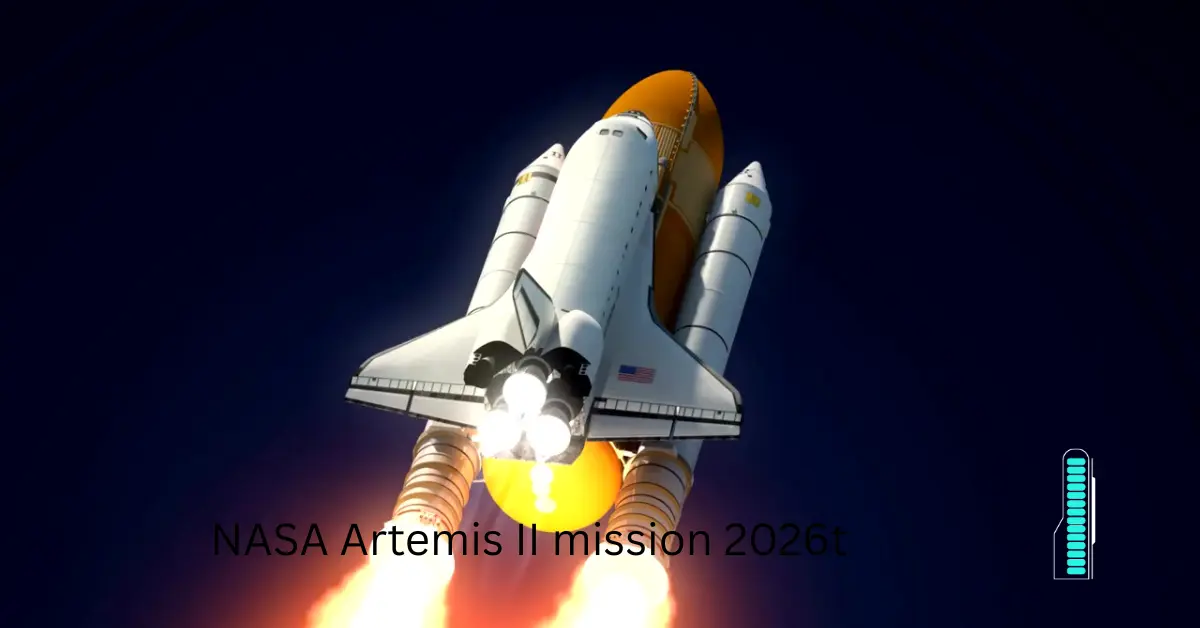
For the first time in more than half a century, humanity is preparing to send astronauts back to the Moon—not to land this time, but to orbit it. NASA’s Artemis II mission represents a major milestone in deep space exploration: the first crewed flight around the Moon since Apollo 17 in 1972. This historic journey is poised to rekindle human ambition beyond Earth’s orbit and lay essential groundwork for future lunar landings and even missions to Mars.
What Is Artemis II Mission/Artemis 2 Mission?
Artemis II Mission is part of NASA’s broader Artemis program, a multi-mission effort to establish a sustainable human presence on and around the Moon. Building on the success of the uncrewed Artemis I flight, Artemis II will be the first time astronauts ride aboard NASA’s heavy-lift Space Launch System (SLS) rocket and the Orion spacecraft into deep space. During its roughly 10-day mission, the crew will travel more than 685,000 miles, looping around the Moon and returning safely to Earth.

Although Artemis II will not land on the lunar surface, its objectives are crucial: to validate life support, navigation, communication, and other systems in the environment of deep space with humans aboard. Lessons learned here will directly feed into Artemis III, which aims to land astronauts near the Moon’s south pole and mark the first lunar landing of the 21st century.
Who’s Going? The Artemis II Mission Crew
Four astronauts have been selected for this pioneering mission:

- Commander Reid Wiseman (NASA)
- Pilot Victor Glover (NASA)
- Mission Specialist Christina Koch (NASA)
- Mission Specialist Jeremy Hansen (Canadian Space Agency)
Together, they represent international cooperation and decades of astronaut training, ready to test systems that will be critical for future lunar surface missions and deep space travel.
Launch Timeline: From Preparations to Liftoff
The path to launching Artemis II has been long, full of careful engineering and rigorous testing. Here’s the timeline of key milestones as NASA prepares for liftoff:

1. Pre-Launch Preparations (2024–2025)
Before dates were on everyone’s radar, Artemis II’s hardware began coming together. The Orion spacecraft and the SLS rocket underwent assembly and integration at NASA’s Kennedy Space Center in Florida. Teams worked to install the European Service Module—an essential component built by the European Space Agency that provides propulsion, power, and life support functionalities.
Throughout 2025, engineers completed stacking the massive rocket and performed numerous system tests, including communications checks and integrated ground system evaluations. These early steps were crucial to ensure that when astronauts climb aboard, everything functions as intended.

2. Wet Dress Rehearsal and Countdown Demonstrations (Late 2025)
A key milestone in every crewed mission is the wet dress rehearsal—a full practice of fueling the rocket with propellants just as it would be on launch day, without astronauts onboard. This test confirms fueling procedures and checks for leaks or other anomalies. It also helps calibrate countdown clocks and all associated ground operations.
Following this, the Crew and ground teams conduct Countdown Demonstration Tests that simulate much of launch day’s timeline, right down to suiting up and boarding Orion. These drills are vital to build confidence that the actual flight can proceed safely and on schedule.
3. Launch Window Opens (Early 2026)
NASA has established a launch window that opens in early 2026. While the official “no later than” deadline for Artemis II was originally April 2026, mission planners have been targeting earlier dates within that window, with several opportunities in February and March.
One of the earliest projected launch options is around February 5–6, 2026, with a series of possible days in that first window where orbital mechanics, weather, and spacecraft readiness align for an optimal trajectory to the Moon and back.
Because the Moon is constantly orbiting Earth, and Earth itself is spinning, only certain days and times within a month offer the right “flight path” that allows Orion to depart Earth’s gravity, loop around the Moon, and return safely with manageable re-entry conditions. NASA refines these windows as launch approaches, based on test outcomes and final simulations.
This video is for educational and informational purposes only. The information presented is based on publicly available sources and current mission timelines, which are subject to change. Space missions may be delayed, rescheduled, or modified due to technical, safety, or operational considerations.
This video is not affiliated with or endorsed by NASA or any other space agency. All trademarks, logos, and mission names belong to their respective owners.
4. Liftoff and Lunar Flyby (February–April 2026)
Once the launch window opens, NASA will select a specific day based on readiness reviews, weather forecasts, and range availability at Kennedy Space Center. On launch day, the SLS’s enormous boosters and core stage will thunder to life, lifting Orion and its crew into orbit.
After reaching Earth orbit, Orion’s deep space maneuvering will take it on a trajectory past the Moon, where the spacecraft will travel farther from Earth than any humans have since the early 1970s. During this phase, astronauts will work with mission control to test every system needed for deep space survival, including oxygen regeneration, carbon dioxide removal, temperature regulation, communication with Earth, and navigation.
5. Return and Splashdown
After looping around the Moon, Orion will set its course back toward Earth. The mission is expected to last about 10 days from launch to splashdown—an exhilarating return marked by a high-speed re-entry through Earth’s atmosphere and a parachute-assisted descent into the ocean, where recovery crews await.
Why Artemis II Matters
Artemis II’s significance goes far beyond the excitement of seeing humans near the Moon again. This mission will validate life support and crew operations in deep space, making it an essential precursor to the more ambitious Artemis III lunar landing.
The data and experience gained from Artemis II Mission will directly influence mission planning, safety protocols, and spacecraft enhancements for the next generation of lunar explorers. In many ways, this mission resembles the Gemini flights of the 1960s—an essential stepping stone that made Apollo moon landings possible.
Looking Beyond Artemis II Mission
After Artemis II Mission, NASA’s sights are set on Artemis III, which aims to land astronauts near the Moon’s south pole—a region rich in scientific promise and potential water ice reserves. Artemis III is currently targeted for later in the decade and will leverage lessons learned from Artemis II to make lunar footsteps a reality once more.
Ultimately, the Artemis program is designed not just for short visits but to establish a sustained human presence in lunar orbit and on the surface. This enduring presence will enable new scientific discoveries and help prepare humanity for even more ambitious journeys—perhaps to Mars and beyond.
Frequently Asked Questions (FAQ)
What is the Artemis II mission?
Artemis II is NASA’s first crewed mission to the Moon in more than 50 years. It will send four astronauts aboard the Orion spacecraft to orbit the Moon and return to Earth, testing critical systems needed for future lunar landings.
Is Artemis II Mission landing on the Moon?
No. Artemis II will not land on the lunar surface. The mission is designed as a lunar flyby, allowing astronauts to orbit the Moon and return safely. The first Artemis landing is planned for Artemis III.
When is the Artemis II Mission launch date?
NASA is targeting early 2026 for the Artemis II launch. The mission has multiple possible launch windows, with specific dates depending on spacecraft readiness, weather conditions, and orbital alignment.
Why has Artemis II Mission taken so long to launch?
Artemis II is the first time astronauts will fly aboard NASA’s Space Launch System and Orion spacecraft, so extensive testing is required. NASA is prioritizing crew safety, which means thorough inspections, simulations, and system upgrades before launch.
Who are the astronauts flying on Artemis II Mission?
The Artemis II crew includes:
- Reid Wiseman (Commander, NASA)
- Victor Glover (Pilot, NASA)
- Christina Koch (Mission Specialist, NASA)
- Jeremy Hansen (Mission Specialist, Canadian Space Agency)
How long will the Artemis II mission last?
The mission is expected to last about 10 days, from launch to splashdown. During that time, the crew will travel hundreds of thousands of miles beyond Earth, orbit the Moon, and return.
How far from Earth will Artemis II Mission travel?
Artemis II will take astronauts farther from Earth than any humans have traveled since the Apollo missions, reaching distances of more than 685,000 miles round-trip.
What happens after Artemis II Mission ?
After Artemis II, NASA plans to proceed with Artemis III, which aims to land astronauts near the Moon’s south pole later in the decade. Artemis II’s data will directly shape how that landing mission is carried out.
Why is Artemis II Mission important?
Artemis II Mission is a critical stepping stone toward sustainable lunar exploration. It validates life-support systems, navigation, and deep-space operations with humans onboard—capabilities essential for future Moon and Mars missions.
Will Artemis II Mission be visible from Earth?
The launch of Artemis II Mission will be visible from parts of Florida and nearby regions. NASA is also expected to provide live coverage and onboard views during the mission, allowing people worldwide to follow along.